GDPI/PME 800
Distal Goal: My goal is to set up an art group with a focus on myth and story. I will run two sessions using art to reflect on a short reading and create a visual to represent how we connect with the essence of the story. I will help facilitate a reflection where we can each enter a “Learning Zone” and choose a way to respond to this image. Online resources ( during Covid-19) used will be Zoom, and Google Docs.
Forethought Phase:
Spend time with my distal goal (end goal) to really assess what it is I want to accomplish and how to best get there. Decide also on what sharing platform to use for text or artwork: (Blog or other platform). I realize that I tend to leap off the platform before fully estimating the time management of individual tasks. But the iteration of this “stage” of planning has been useful to me – in a sense refining it with more purpose- so it could be an advantage to come back to it frequently.
Research :
Ongoing. This was great fun. I spent several hours dipping in and out of articles and theses and readings and blogs on this topic to depth some of my ideas on Current myth and story – or ‘The hero’s journey’. I found this moving and it changed the way I think of myth and journeying – and how I might incorporate it as art for myself in my own and shared journeys as art teacher. I listened to Pinkola Estes audiobook “The beginners Guide to Dream interpretation – as dreams and Myth are very closely linked. Books I found useful were James Hollis: Tracking the Gods: The Place of Myth in Modern Life, and Julia Cameron The Artists Way. I decided to use one of Pinkola Estes stories from her book Women who run with the Wolves, called ‘Skeleton Woman’; a myth about the life/death/life nature of love. For the second story, I chose Robin Wall Kimmerer’s ‘Skywoman Falling’ a Creation text of Turtle Island, from her book Braiding Sweetgrass.
Inviting the Group to attend:
Design Flyer/ Invitation – with dates and rationale. Request 2x Hour long Art making sessions AND Intro and Exit Zoom meetup ( I hour each) Total +- 4 hours commitment over two weeks. Add RSVP by….by date. (The time for this was longer due to decisions I had to make about asking the group participants if they could do this in the short time frame, how we could present and share their work, and I had to work out what I needed from my group. Things kept popping up I hadn’t thought of – as decision making! I did a few information flyers around this time, as it was important to me to keep the group informed of what they were getting into; as well as sharing my own need for support and learning during this time. (Roughly 3-5hours)
August 11 2021
Proximal Goals Worksheet
For a fuller version of the Proximal Goals worksheet and time frames – see the link below.
Introduction to participants for Myth/Story and Art.
Zoom meeting (80 min)
What to bring to Zoom Meetup: Participants all need an image to share( 2D or 3D image)
Welcome + Intro to outline of hour together: We will have a short intro from me, then participants introduce themselves and an image they brought with them ( what they enjoy about the image, and they will have time to say what expectations they bring for the Myth/Story & Art sessions); Then I will give participants an outline of 1)what I need them to do to help me in this learning zone (project for Self Regulated Learning Module), 2)Explain their art exercises & reflection exercise, 3) Include my intention to upload our images to the Content Blog – with their permission, and let them think about this, 4) Briefly talk about the Hero as mythic figure in historical narrative, about our connection to this archetype; and, the hero as contemporary figure in modern media.
Use this question to think about during session: Using myth/story and artmaking, can we connect with the myth in our own story, and learn from each other? And, how do we move beyond our own reticence or fears of art competency to do this? This is a journey of accompaniment.
Quotes to set the mood:
“Just as the association with others assists our survival, and supports our need for community, so membership in the group sometimes exacts a price which sometimes jeopardizes the psychological integrity of the individual. How we are to understand ourselves as ourselves is the psychological task of myth.” James Hollis, Tracking the Gods
“We can be not much at home in the world we have created” Rainer Maria Rilke.
These quotes contain clues on why myth and story could add potency to our art making and reflective practice, link us to our own story, and the wider story of our time.
Meet and Greet (talking circle usually ) 3-4 mins. each. Participants share a favorite image with the group. Good starting point. They might want to include something from their image in their intro and respond to other aspects of myth or story. Answer Q : Who we are and what do we want from this time? Participants can outline their hopes and expectations for the group exercises.
Framework for working together: What shall we do? How shall we do it? How long will it take? Outline some basic structure for the art/ story process, some ideas of myth and image-making to give hooks for people to hang things on (ways of connecting them to the story). What to do with distractions? Non dominant hand – as they prefer. Materials: Check people have what they need? Go through the exercise format : They will set up intentional and fairly quiet space, then prep art tools, and read/ listen to story (10 mins). Then begin artwork (45 mins). Then reflect on the experience of their thoughts and feelings during the time of making art.(15 Mins).
This is the format they will do on their own. Prepare/ Artwork/ Written Reflection
What this time is not….. this is not performance/ not end product oriented. This is not a literal representation of the story. Start with an aspect of the story that touches you and do painting/drawing/ unseen/non dominant hand – any method that will let you start the process spontaneously. Go from there to explore whatever images seem to be present. It is likely that images come up from the story or imagination that they are not comfortable with or unsure how to represent visually – and how to approach this. Permission – exploration and flowing curiosity. Can be an entirely abstract piece….or finding a relationship between colours or, symbols or shapes can represent what you want them to express. Text or bubbles – or stick figures, anything goes. Work in any single medium or mixed mediums or collage. 2-dimensional artwork or 3-dimensional, anything is fine.
Give time for Questions from participants.
Notes: Story downloads and reflection prompts, will be posted to WhatsAPP group, for both sessions; Go through Q for reflection now.
Time for Questions from participants about any of the suggestion or for the reflection prompt exercise.?( +-10 mins). Also if they have any questions in the next ten days they can reach me on WhatsApp or e-mail. As images are done they may want to post them to the group WhatsApp, or add a message or a question. But the main sharing of artworks and reflection exercises will be done at the final session on Zoom, after they have done both art reflections.
The purpose of myth is to bring about greater meaning by imposing pattern upon chaos. The formulation of different archetypal elements are in Jung’s terminology – imprinted on all human beings. Our human consciousness does not invent such patterns, it recognizes them as though they have come from another place whose familiarity strangely moves us.
James Hollis : Tracking the Gods the Place of Myth in Modern Life
End of Introduction for Participants
_____________________________________________________________
After Introduction on Zoom: Posted to WhatsApp: Myth/ Story Text – See Below
Exercise 1: Skeleton Woman (about the Life/Death/ Life nature of love) from Clarissa Pinkola Estes, author of Women who Run with the Wolves.
Exercise 2: Sky Woman Falling: a Potawatomi First Nations Creation story from Robin Wall Kimmerer, author of Braiding Sweetgrass.
Prompts for participants own sessions: Making.
This handout was posted to the WhatsApp group after the Intro meeting.
Times: for Set-Up (10 mins) Artwork time 45 Mins and for Write up Q’s/ reflection at end (15 mins) Pack up ( 5 Mins) ; each time total +- 1.15 Hour
Reflection Prompts: Use one or more questions to facilitate your thoughts for writing.
- What was the focus of the artmaking for me? (possibly physical movement, thoughts, feelings, distractions). What struck me? Can I note what these are?
- How does the image connect to or lead on from the text?
- Does the artwork connect me to the text/ story or to myself? How would I explore this image in another artwork?
- Does any part of the image draw me or make me feel uncomfortable? What could it be saying?
After the exercise in Myth/ Story and Art, end your reflection time with a gratitude gesture.
“There is a natural order of life and it is pure creative energy. There is an underlying, indwelling creative force infusing all of life – including ourselves”. Julia Cameron, The Artists Way (1974)
END OF PLANNING FOR SESSIONS
Jane Mennigke/ Myth and Story Group Exploration Introduction/ August 2021
Gallery of images from participants for 2 Art reflections on Myth/Story :
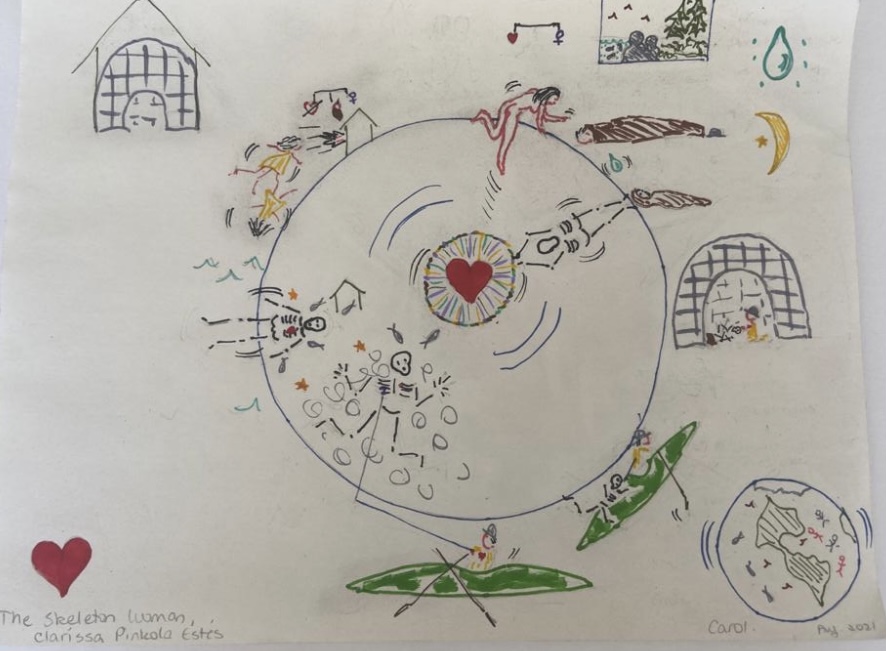
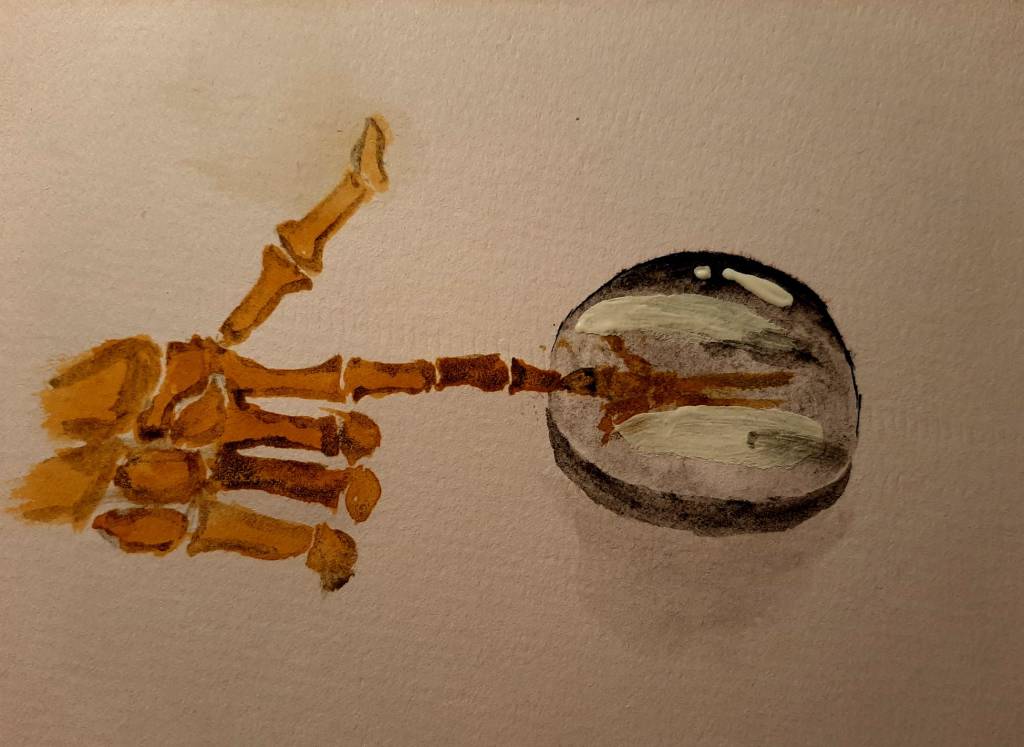
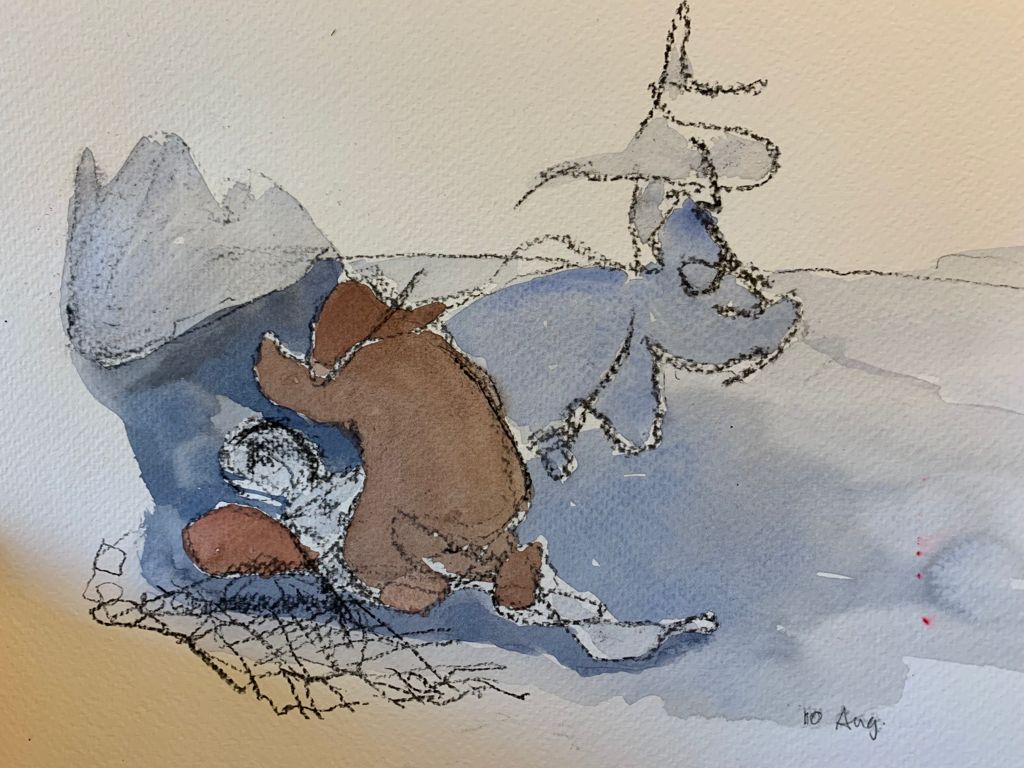
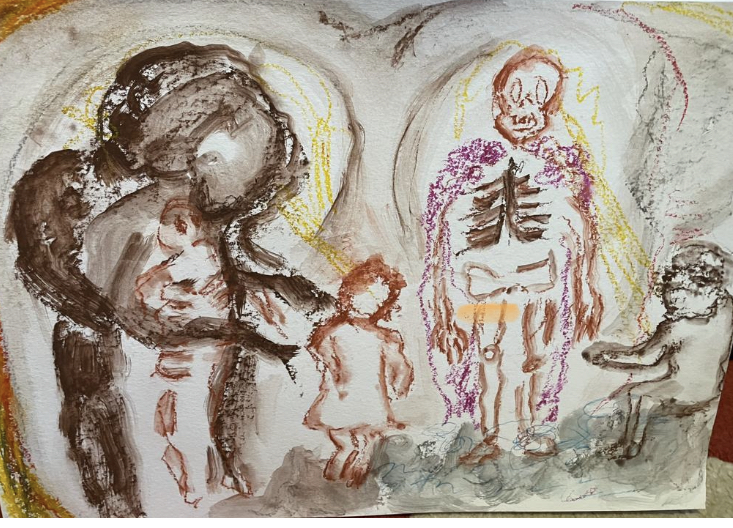
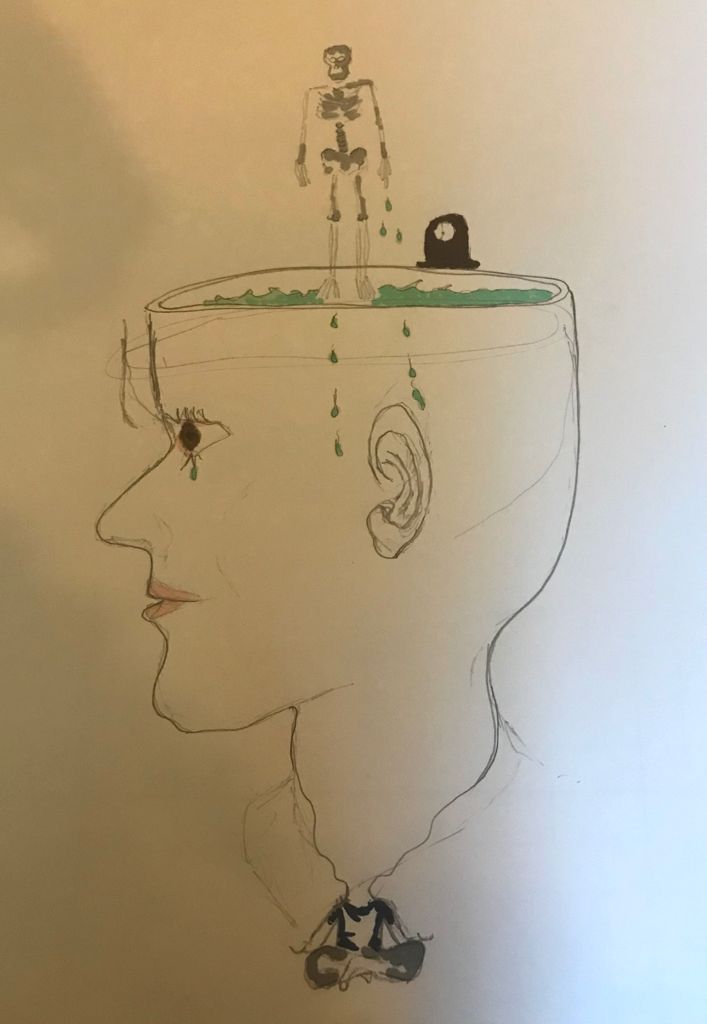
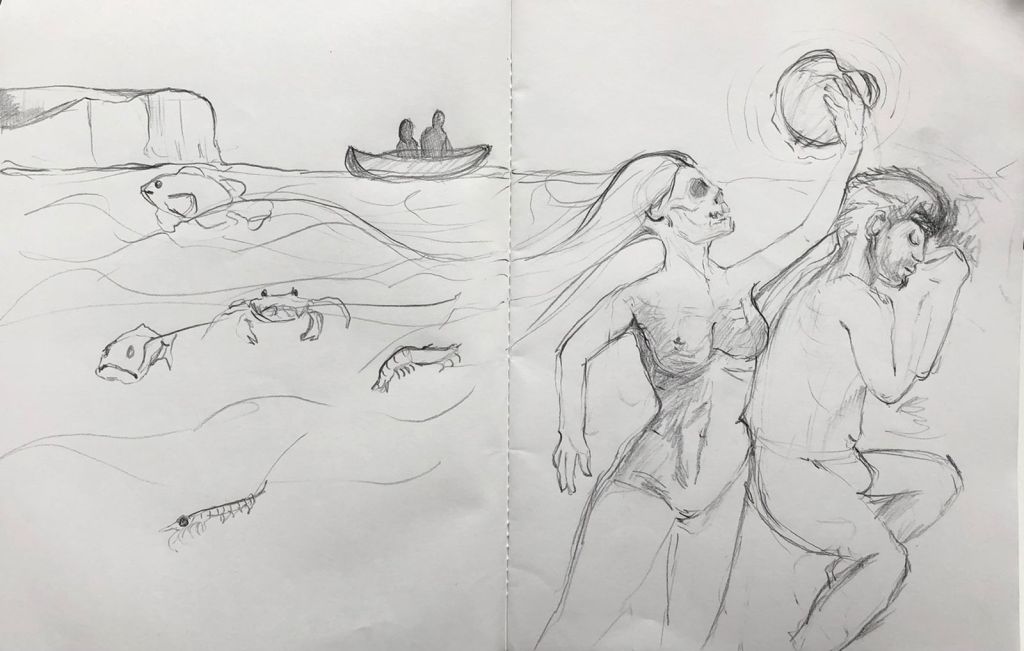
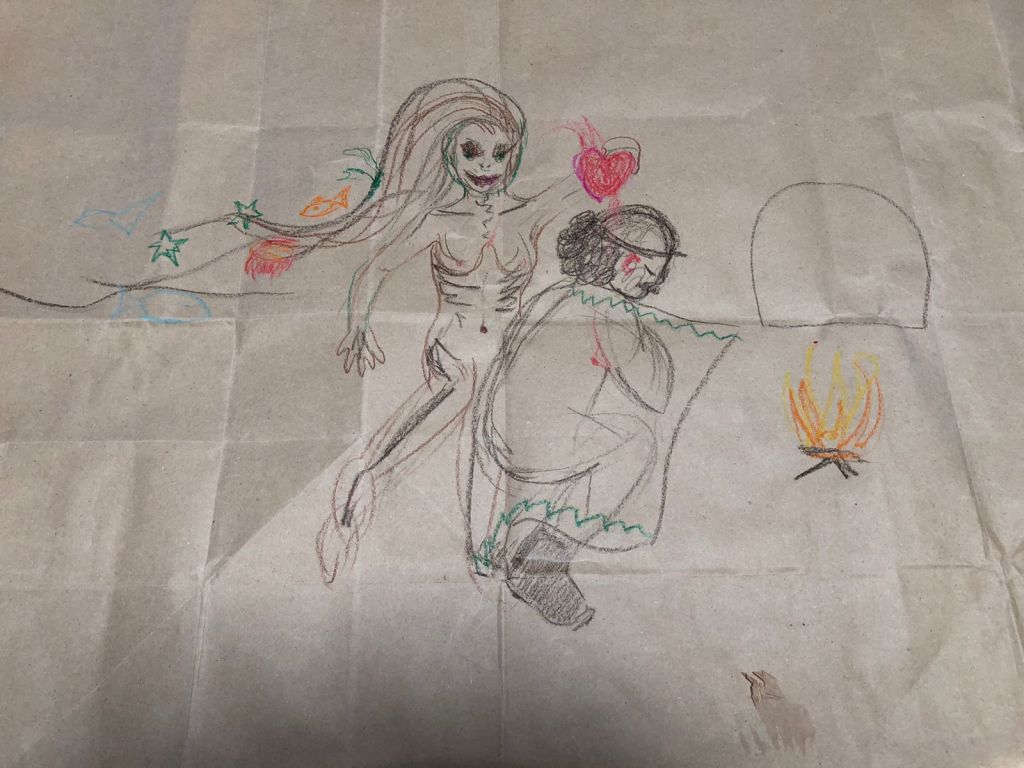
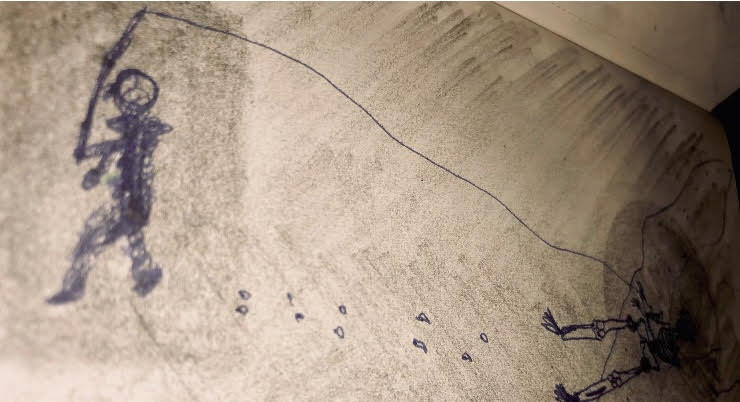
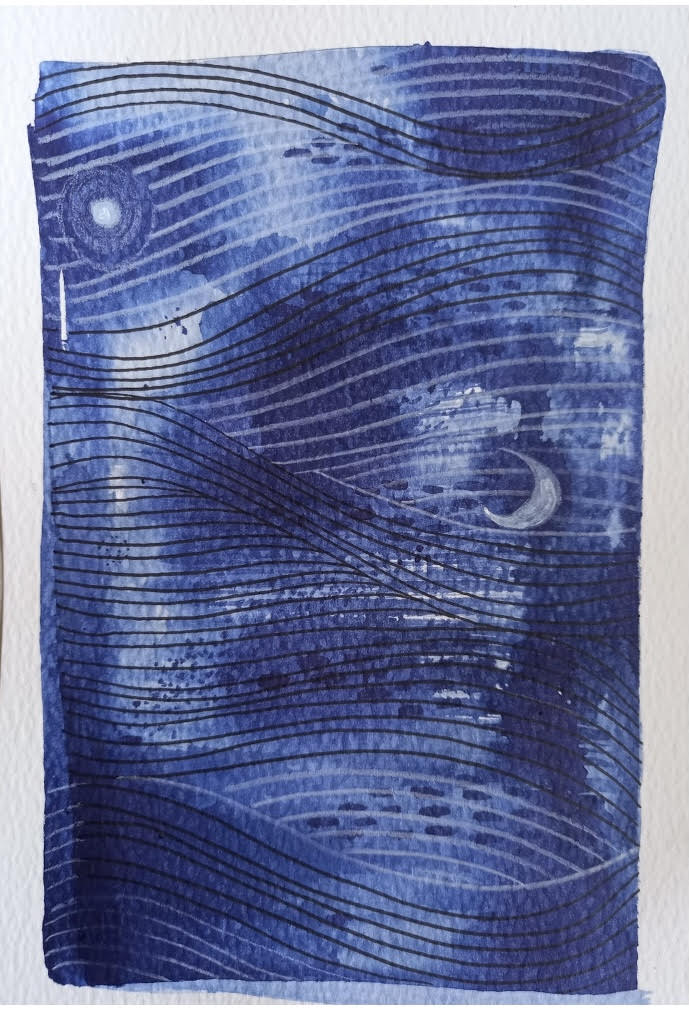
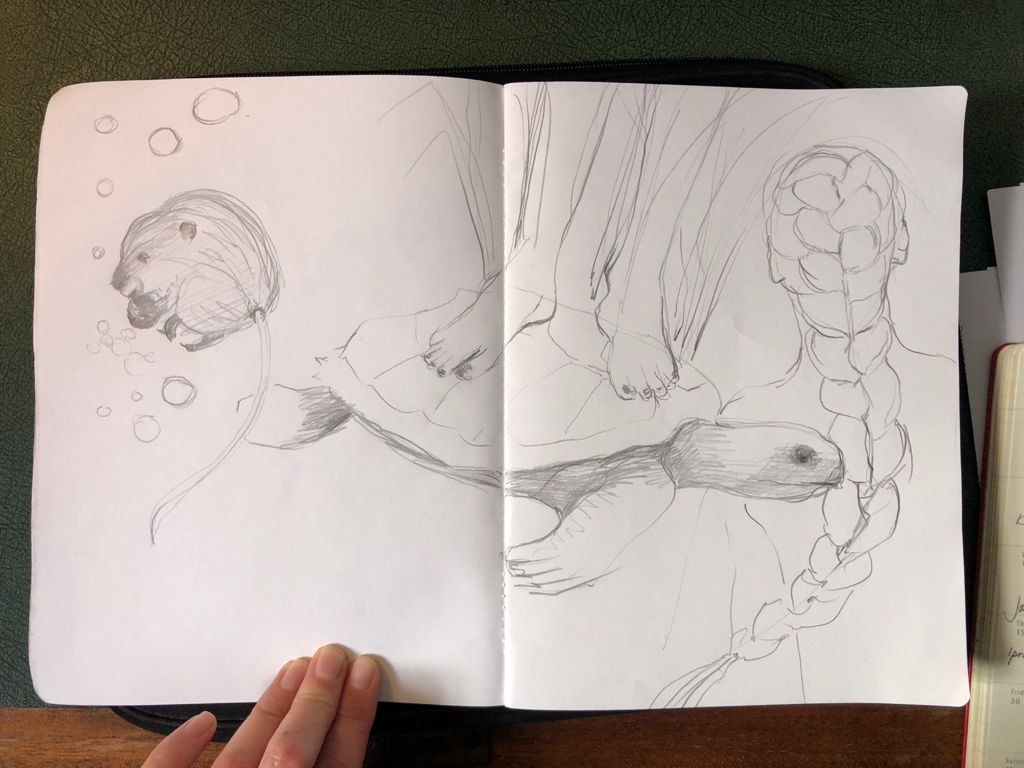
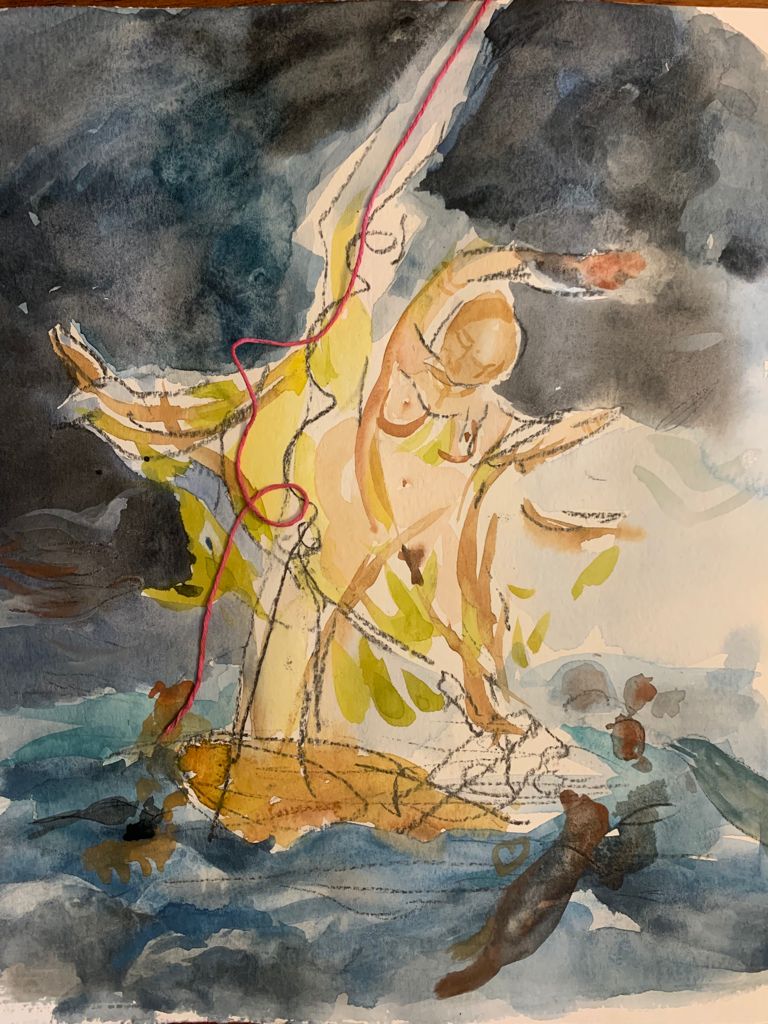
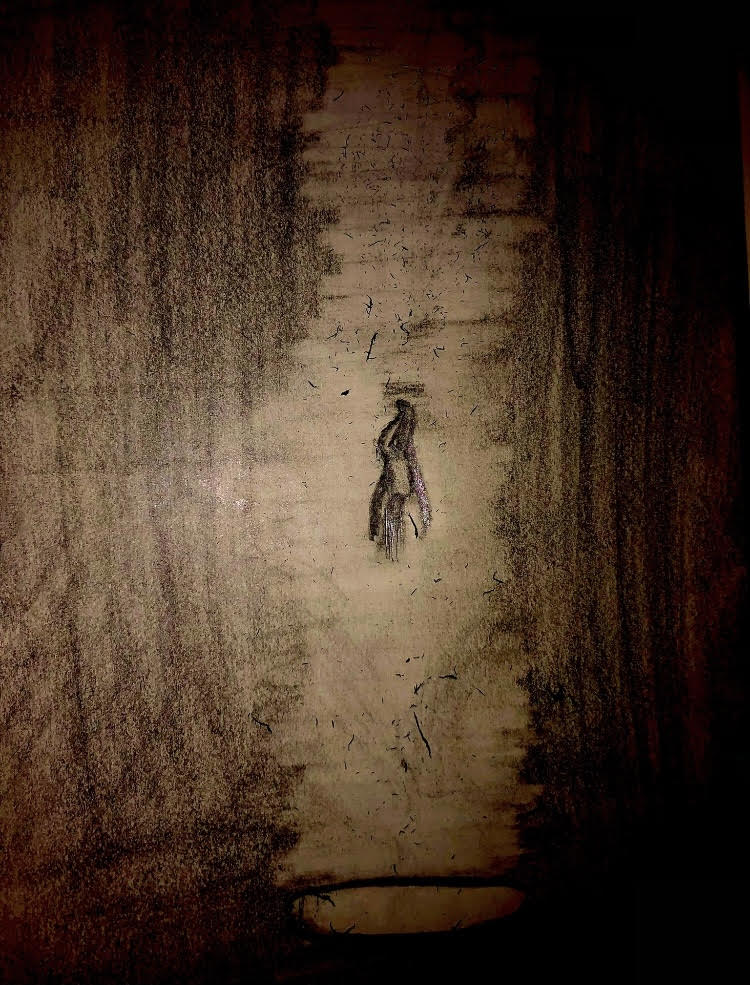
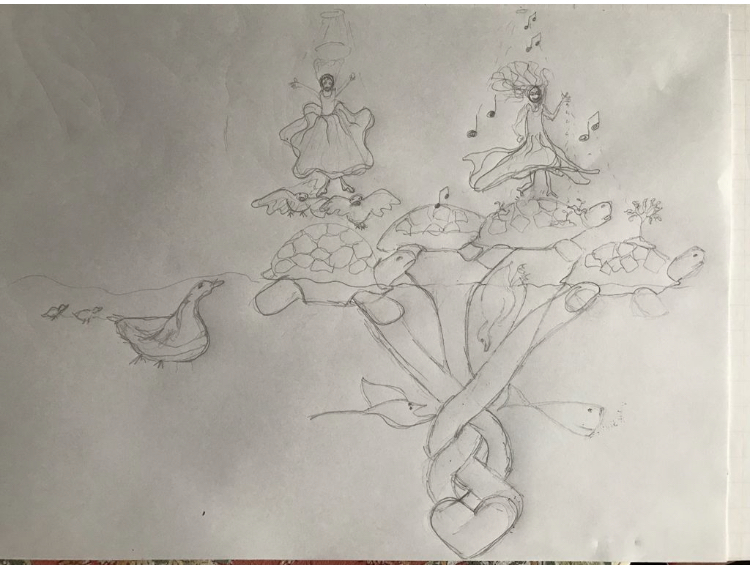
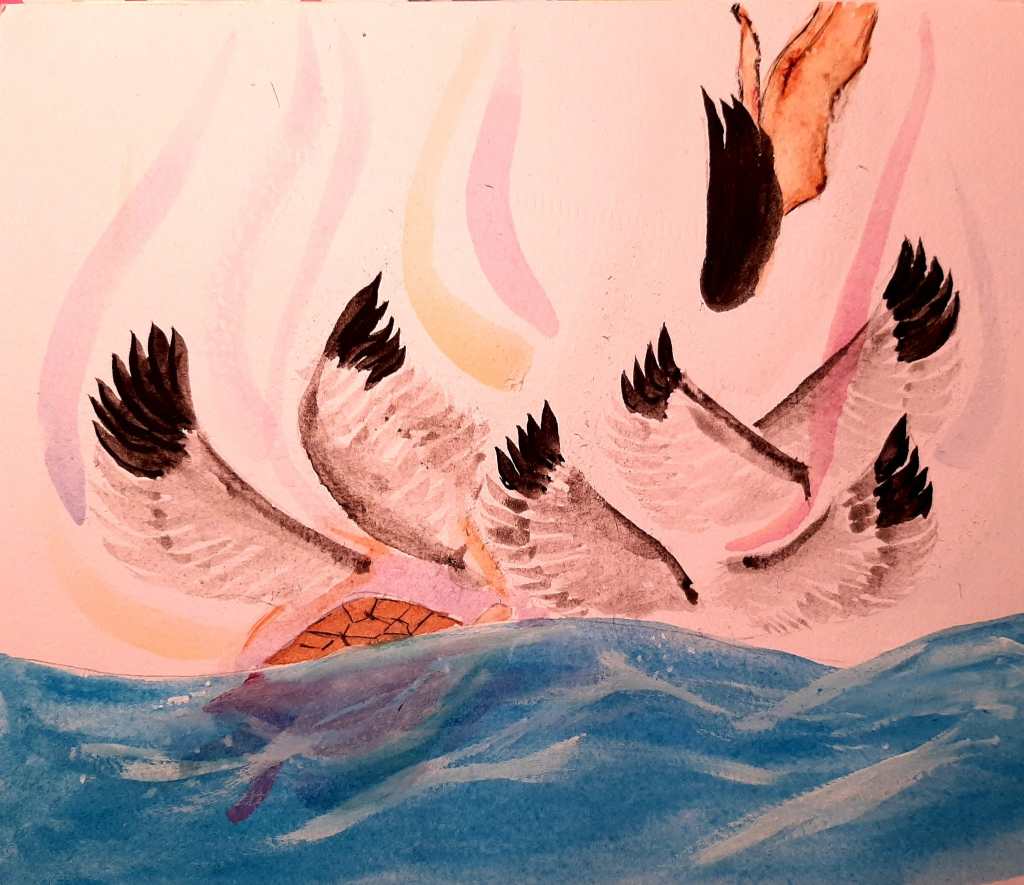
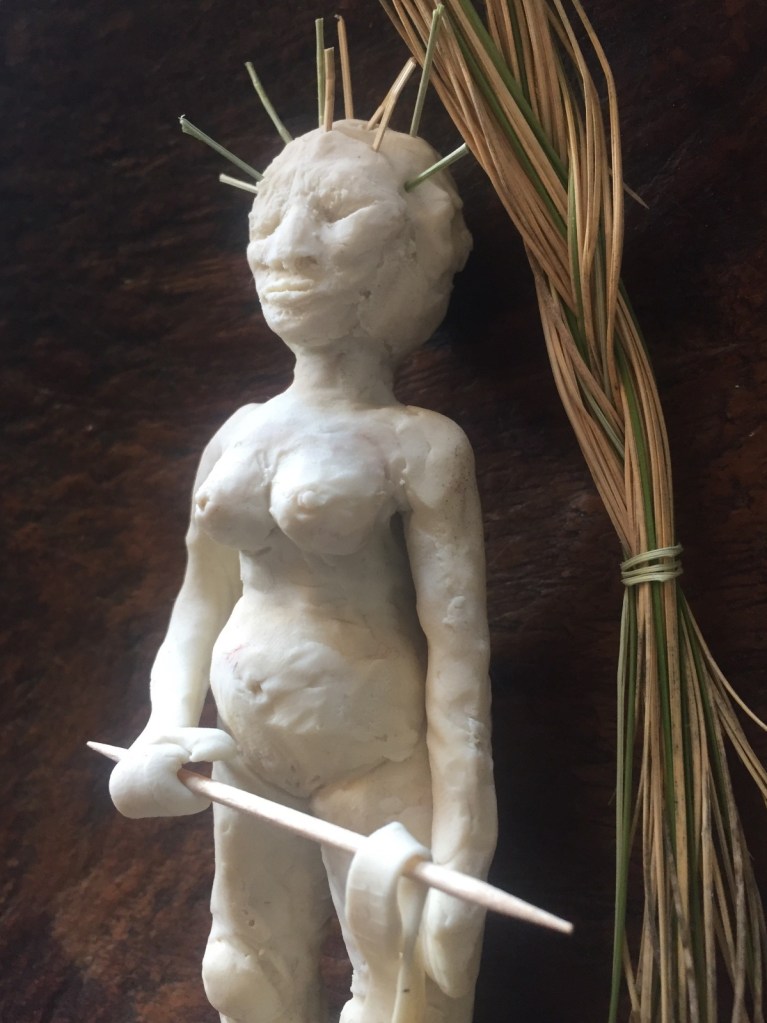
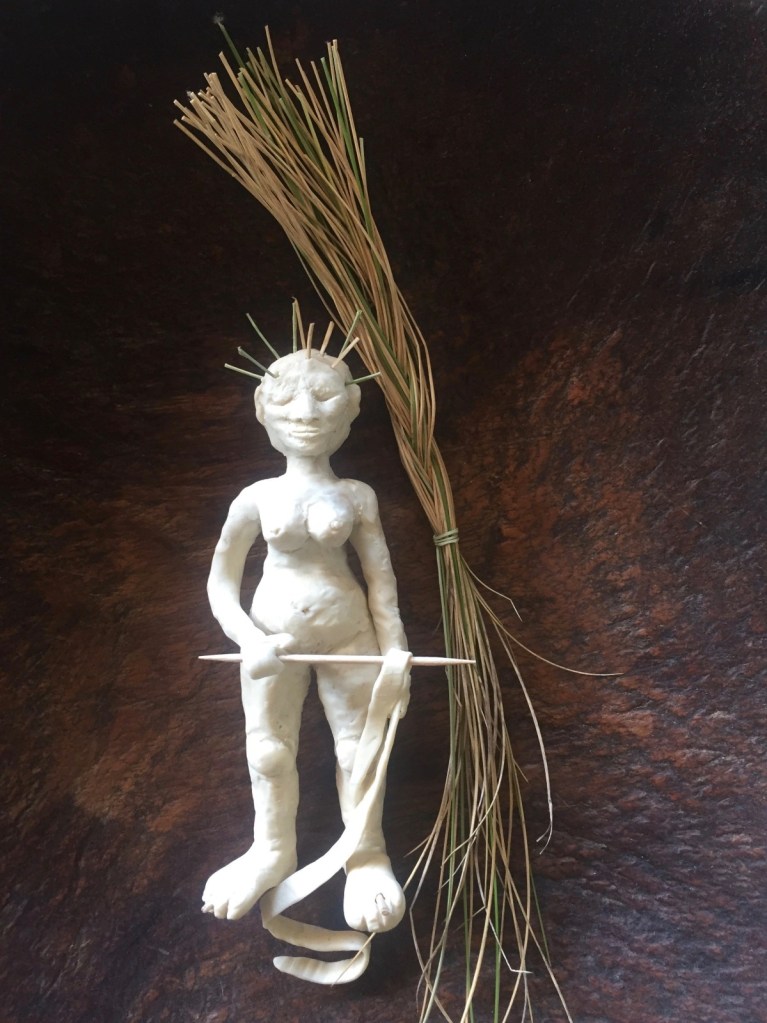
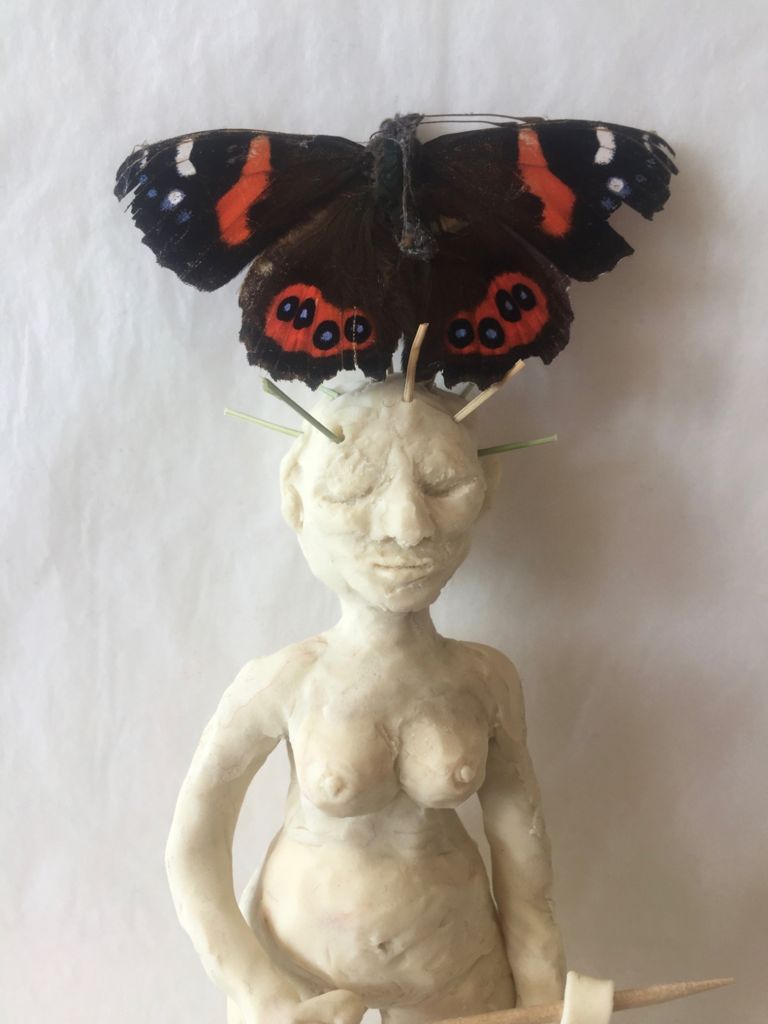
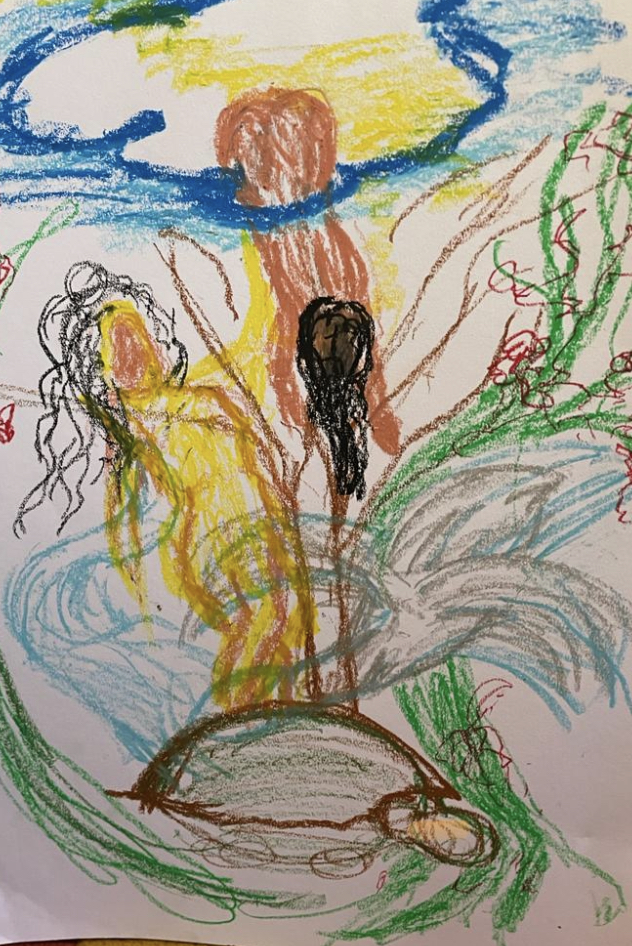
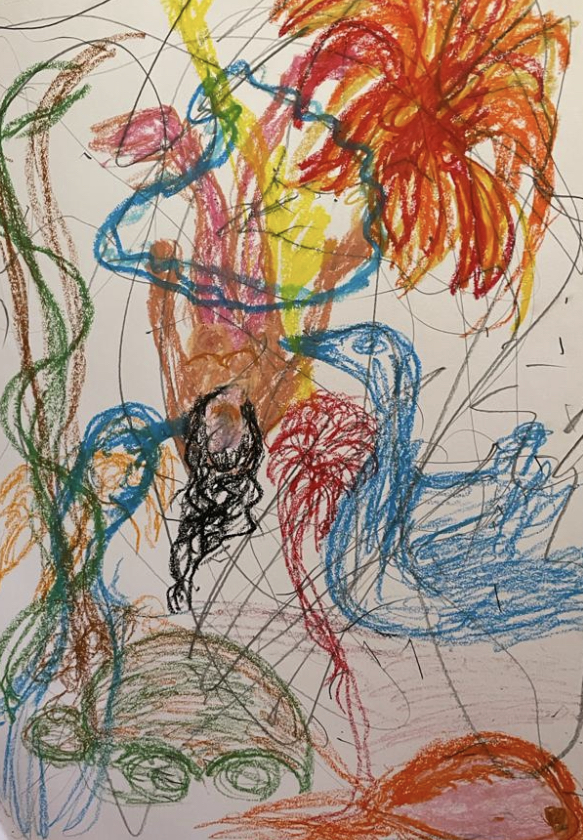
There were 9 participants from New Zealand, Australia, Canada, USA, Switzerland and South Africa (4 in 1 group and 5 in the other). Each person created an art images on their own, in any medium available, after reading the the Myth/ Story text at a time which suited them – in all the different time zones. After making the image they did a written reflection on feelings, thoughts, distractions or attractions which might make them want to continue the image idea at another time.
Image 1 is based on the Myth of Skeleton Woman. An Inuit Tale, on the Life/Death/ Life nature of love. Image 2 is based on a Potawotomi Indigenous Creation Story of Turtle Island. The reference for both narratives is included in the Reference section at the end of this document. The Artwork is my favorite part of this SRL project.
Each image represented here was shared on WhatsApp – for a a final Zoom session. by participants who reflected on their journey of making the artwork, what stood out for them, and how the artwork had been a part of their life experience in the week. The best analogy I can give to reading these images is that they are like an encounter with dreams. So allow yourself to be invited into this space. I need to add that feedback from the participants was very dynamic . By this I mean that the images had stirred a tremendous expanse of inspiration and creativity in their lives during the week, which had snowballed into other areas of their lives.
Feedback from participants:
“This was a very enriching experience! The act of drawing shifted my interpretation of the story and what it meant to me in the moment. Also, focusing on the myth somehow changed the way I feel about drawing. Jane’s workshop provided a space for me to discover and begin to explore that. Thank you, Jane! “ Jessica A.
“For someone that does not read much mythology or make time for drawing or painting, this workshop combining the two was interesting, challenging and enjoyable. It definitely felt like something in my brain got turned on. I hope to do more of both, and to combine them again – rich learning and experience. Thanks Jane!” Carol L.
_______________________________________________________________
Reflection on Connections between Inquiry and use of Self Regulated Learning (or SRL).
The goal I chose was to implement an Art Reflection Group with a focus on Myth and Story.
I had wanted to do this for a long time. I believed I had the necessary skills to do it, but I had lots of anxiety about whether I could truly get participants to get as excited about it as I felt, or to pull it all together. I have also had severe blocks to artmaking at times in my own life. The purpose was to enter a Learning Zone with participants so that I could learn if I could do this, and monitor ways of dealing with my inner critic, which I would share with the group. I approached a group of people and they agreed to try it.
Goal refinement: I spent a bit of time going back and forth with my plans for what was possible in the time available. Time management is not an area I excel in. I always underestimate how long things will take. However, part of SRL is to make goals measurable and specific, and monitor as each step progressed. This I did.
There were two areas that I benefited from most during this enquiry.
The first was collaboration: As part of my research for this project I reached out to two professionals who I knew had more experience than I did in theory and practice; an art professional, and a therapist. Their expertise added practical research to other theoretical research I did on the historic legacy of myth in different cultures, and my readings on the hero’s journey in modern media. I am familiar with and often work with dream theory, art or journaling practice for myself, but I was grateful that I had recently read the Iliad and The Odyssey. Homer’s accounts of heroes and their relationships to the Greek gods in everyday life is so vivid, and so widely referenced in western art and drama canons throughout history. The relevance of myth to our current times is undeniable. Cross cultural myths and stories impressed me with their modern “currency” – their usefulness in interpreting common global and social issues today. Apart from readings, I did art sessions exploring myth and artmaking. I reflected on process and what I was learning as a result. I shared these sessions with my collaborator Claire, and worked through difficulties in anxiety and process with Myrna; these collaborations increased my confidence. They were upbeat, supportive and knowledgeable.
The second area of intense learning was monitoring; It helped to have course-peer feedback on goal setting and difficulties or challenges. This played a supportive role and acted as an accountability check. I kept going back to refine the initial goal, and tried to stick to the monitoring process more closely than I ever do! Goal and time adjustments was the second area of my biggest learning in the SRL process. In the area of self-efficacy this SRL project has really helped me believe that I can achieve my goals in the time frame I set if I am realistic, specific, and monitor the process closely.
To really pay attention to this in the classroom: Monitoring of tasks is a discipline that is best done by the learner themselves; To truly benefit from the confidence-building aspects of goal setting and achievement, self-monitoring works best. But it often takes time to build the skills needed for self monitoring. This is an area of learning like any other and they need help and instruction on different aspects of self monitoring to do it.
Next steps. In the Classroom: I have been experimenting this year with different kinds of self-assessment for learners in Visual Art classes and Career Life Education. I have found that task monitoring is more pleasurable for both of us if they know they will also be assessing their own work, and peer monitoring is more constructive as well. I have found students to be very accurate on the whole, with assessing their grade for a task; but I think this SRL project has prepared me better – to train students in individual planning and goal setting, to achieve better monitoring of proximal goals so they can achieve more pleasure and motivation, and to help them analyze what supports and scaffold they need as they move toward achieving final goals.
I still need to develop additional SRL teaching resources for the different grades I teach, so that is what I am working on, going forward.
References:
Professional consultation on Whatsapp and Zoom. With gratitude to the two consultants below, Myrna and Claire, who enabled me in this project, and to the participants of the groups who further acted as my guides and enablers as they embarked on this journey together with me.
- Myrna Wajsman- Lewis, a clinical psychologist working in Sydney Australia, who I have had contact with over the years and whose mentorship and research into process work, and archytypes in art and therapy has expanded my own thinking.
- Claire Beynon, a professional artist and poet working in New Zealand, whose art practice and workshops have included non representational art, symbols and archetypes, and the liminal space between music, and 2 & 3dimensional art. Her innovative multi faceted work and approach to art and life has always inspired me.
I know them both well and admire their professionalism. I knew they would help me focus on essentials and process, and be excited to participate in enabling me in this distal goal. So, while fleshing out ideas for the workshops I wanted to run on Myth/ Story and Art I was able to put my ideas out there and get some solid feedback on what I could accomplish, and how to keep my fears and anxiety about artists block from acting as a deterrent. I am extremely grateful for their input and encouragement, which really made this workshop possible for me. It was everything I had imagined it could be – and more. Both Claire and Myrna decided to join the art workshops, which was an awesome way for me to receive feedback on process, but for them to engage with myth and story in this way as well by being a regular part of the group.
Book resources:
Cameron, Julia. The Artists Way. Tarcher Putnam, New York, 1992.
Kimmerer, Robin Wall. Sky Woman Falling. Creation Myth of Turtle Island. Braiding Sweetgrass, Indigenous Wisdom, Scientific Knowledge and the Teaching of Plants, Milkweed Editions, 2013. Canada.
Hollis, James. Tracking the Gods, the Place of Myth in Modern Life, Inner City Books, TO, Canada
Pinkola Estes, Clarissa. Skeleton Woman Myth. Women Who Run with The Wolves, Myths and Stories of the Wild Woman Arychype. First Ballentyne Books, 1995
Pinkola Estes. Clarissa. The Beginners Guide to Dream Interpretation, Sounds True, Publication. 2003, USA.
The books above were used for their wonderful help. I choose two myths for the groups to use as a springboard for their art reflection:
- Skeleton Woman from Women who Run with the Wolves about the Life/ Death/ Life nature of Love; and
- Skywoman Falling, from Kimmerer’s book Braiding Sweetgrass; An indigenous Creation Story about Turtle Island.
All other books added quotes and thoughts to clarify my goals and intentions when planning the introductory presentation workshop and the exercises I wanted people to participate in. I had to plan supporting documents, and I did a trial run with Claire on one myth and artwork – so we could compare notes afterwards – and before I did the introduction with both groups.
The web-based articles and research below, located me in the here and now. I wanted very much to connect participants to the aspects of myth that are current, contemporary and yet mythical and historical at the same time. These articles’ enabled me to do this, by adding contemporary prompts – and supporting the ideas I have had that we are all called to be heroes in our own story and oftentimes in the wider story of life.
Web based research:
- The mythological perspective of modern media: Cross-cultural consciousness and modern myths. Evans, Rebecca E,. (2018) James Madison University.
A quote from her thesis abstract:
“This piece assesses the cultural implications of modern narratives that incorporate classical mythology, specifically focusing on the hero’s journey. When the similarities of different myths across different cultures are analyzed, it becomes clear that there are modern analogs that incorporate mythic qualities and cultural values. These mythic foundations are analyzed here in popular works like Harry Potter, Star Trek, and Legend of Zelda, where the hero’s journey becomes an almost universal experience that inspires cross-cultural consciousness”.(cont.)
2. Why Are We So Resistant to the Idea of a Modern Myth? Ball, Philip (2021). LIT HUB, via University of Chicago Press.
“Why are we still making myths? Why do we need new myths? And what sort of stories attain this status? In posing these questions and seeking answers, I shall need to make some bold proposals about the nature of storytelling, the condition of modernity, and the categories of literature. I don’t claim that any of these suggestions is new in itself, but the notion of a modern myth can give them some focus and unity. “
Ref: https://lithub.com/why-are-we-so-resistant-to-the-idea-of-a-modern-myth/
Final Notes and Strategies: A really nice simple step by step outline below, for SRL strategies, reminded me that we often don’t know everything we are doing to monitor ourselves. Being conscious of these steps can feel like attainment towards our final goal. We are more prone to see successes and not just struggles.
SRL classroom strategies:
Ref: https://nrcgt.uconn.edu/wp-content/uploads/sites/953/2015/07/sr_printversion.pdf
Jane Mennigke/ New Resources/ Module 4 / Self Regulated Learning / Myth and Story/ Final Project/ 2021
 Songololo Times