Connecting with Professional Communities in my Area of Practice.
1. Visual Arts
2. Career Life Education.
Comments:
Please find a Comments section at the end of the page to add a comment, engage with a question, or offer a new resource you have found helpful in any of these learning areas.
________________________________________________________
Contents for this page:
- Comments on Module 4 resources; readings and audio which contributed to my search for communities of practice in my field.
- Jennifer Gonzalez /website on tech use and updates for instruction.
- Susan Florio-Ruane / Article leading to my personal response on TRC recommendations.
- Blogsites and Websites researched and joined for professional community connections– see Visual Arts and Career Life Ed resources.
1. Readings and Video resources (Module4)
Sugata Mitra’s TED talk on The Child Driven Education (2013) gave research examples of what children are capable of in different computer-learning contexts, and in difficult socio-economic conditions which are normally thought to hold little success in education. Mitra clearly sees schools going to Instructional default settings which limit educational opportunities for child driven education. This drives his exploration in interactive tech-learning-platforms in different social contexts which children from poor neighbourhoods can access.
Apart from demonstrating the success of his student-models in these neighbourhoods and streets, he also demonstrated the over attachment schools and classrooms have with sticking to old curriculum models/practice and he offered a strong alternative for new interactive media. Mitra, S. (2010, July). Sugata Mitra: The child-driven education [Video file. Retrievedfrom http://www.ted.com/talks/sugata_mitra_the_child_driven_education
I found the Carol Watson(2013) article painstainkingly dismantled our carefully-cultivated teacher cooperation and status quo efforts in our Professional Learning Communities (PLC’s). The desire to fit into the school ethos, mission and values is a strong urge for teachers; to be seen to be cooperating. I was surprised by how much I enjoyed her article, which nibbled away at the concept that good learning systems need to be run smoothly by PLC’s who all support the status quo. She writes that diverse, divergent groups with contrasting ideas is more likely to benefit the educational progress of the learners they support. This thread in her article interested me, particularly because I hate conflict. But, I know it can be useful and there are too many thorny issues in the real world for us to ignore dealing with this constructively in our PLC’s as a model for change in schools.
It was a good article for delineating what the advantages were: A degree of chaos and energy which is invigorating for learning, also, a degree of thoughtfulness and evaluation about currents contexts which need change. Watson, C. (2014). Effective professional learning communities? the possibilities for teachers as agents of change in schools. British Educational Research Journal, 40(1), 18-29.
13 August
Other Websites in online learning which piqued my interest because they were so darn good!
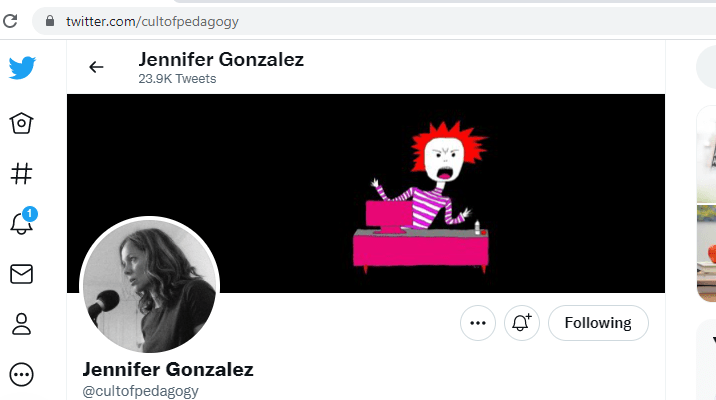
2. Jennifer Gonzales and Teacher guide to Tech.
This is something I could really use over time. It is a sleek website on teaching tech platforms to teachers so they have multiple resources for different sorts of instruction needs. Their approach is well researched and practical and trendy. This could help me bridge some gaps for myself and I think my students would benefit. I really need to start working more often with websites like Canva and Sketchbook Pro, Photoshop and other art and animation Apps. Whew! Too much to learn always! It’s a lot! Start somewhere!
For info on this website see: Jennifer Gonzalez @cultofpedagogy
or at http://teachersguidetotech.com.
3. Susan Florio- Ruane.
Have you ever had goosebumps while reading an article? I did while I was searching up another site and found Susan Florio-Ruane’s (2001) article on using autobiographies and cultural narratives to engage teachers in PLC’s with a different vision of multiculturalism and its benefits for education. This is not aimed at students, I mean it is, indirectly. It’s aimed at changing teacher mindsets on issues of culture, and ethnic differences through autobiographies and thus making them better teachers – who can use this method in the classroom to engage dialogue, collaboration and respect among learners of different cultural backgrounds.
“She suggests autobiography and conversation may be useful for teachers not only in constructing their own learning about culture, but also, by doing so, in participating in the transformation of learning within the teaching profession.” I thought of one way her concept could be utilized immediately within my own PLC’s.
The Truth and Reconciliation Commission Committee (TRC)* have provided a range of online resources for teachers with this concept in mind. There are recommended video links, books to read (like Wall Kimmerer’s Braiding Sweetgrass, or 7 Fallen Feathers by Tania Talaga, or Richard Wagamese Ragged Company, and, Thomas Kings Massey Lectures: The Truth about Story. I have used elements of these in the classroom before and they invite dialogue and give students a better understanding of Indigenous history of residential schools in Canada as well as a respect for cultural narratives and creation stories. I still have a lot to learn and to share this strategy in a PLC with my colleagues would be a very rich experience.
For further research on the Recommendations of the Truth and Reconciliation Commission to the Canadian Government see the government website: https://www.rcaanccirnac.gc.ca/eng/1400782178444/1529183710887 or search for online resources for reading – recommendations from the TRC Committee on Indigenous Literature.
Florio-Ruane’s concepts for PLC’s provide another model for learning which is relational and has a more ontological (the study of being alive and existing) or anthropological approach.
Florio-Ruane, Susan (2001). Teacher education and the cultural imagination: Autobiography, conversation, and narrative. Michigan State University.
Have you stopped reading yet? Its hard getting into topics of Indigenous literature. But its OK to be unsure or to feel unsettled. Our students will value our participation in and our unravelling of topics on Indigenous experiences before and after settler contact. It helps them be informed, understand the dynamics in social systems in their country that they have always thought were just the way things are, and start to question how they began. WE can all do it – in our PLC’s with other teachers, and in the classroom – and use the books to enter a collaboration with teachers and students in a Learning Zone similar to Florio-Ruane’s idea and in the manner of Eduardo Briceno’s TED Talk.
4. Identifying professional communities to belong to or participate in: This course has shown me ways in which curriculum conceptions and approaches can be developed within different learning areas in practice. I will choose One (or more than one) Visual Art Site, and One Career Life Education Site for starters!
14 August:
The Student Art Guide : This is a valuable, very well resourced and managed website also linked to Facebook, YouTube, and Pinterest.
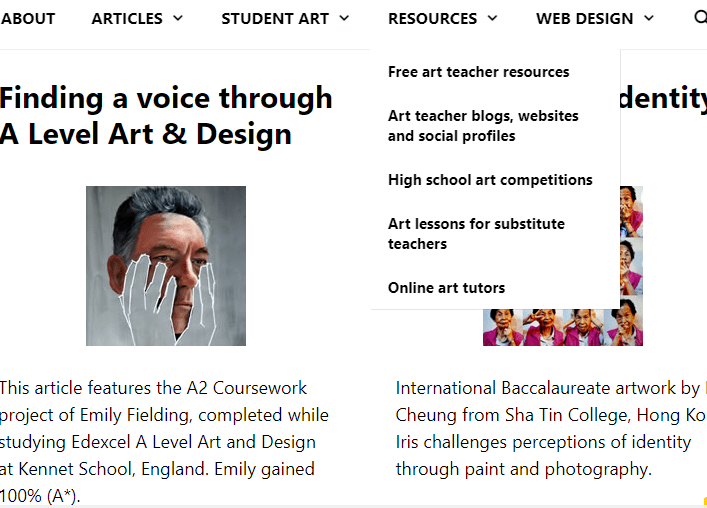
See : http://www.studentartguide.com
There are Lesson plans, Sketchbook and project ideas. A Level – Art projects and art process journaling really gives me good idea’s about student project capabilities and new challenges for the artroom!
There is a lot of student-led dialogue about projects on the sites so my students would benefit from the resource; its not just for me. It has a Subject Centred approach with strong links back to historical canons in art and art history. Slight downside – This is a Eurocentric website and that angle needs some changes in a Canadian/ North American setting. But, new technologies are also explored and referenced. Social issues form much of the teenage subject matter such as Identity, Body image, Social expectations, Gender, Refugee crises & Displacement, or Anxiety – which are cross cultural issues. This tends to be student driven and add to research and inquiry. There is a remarkable showcase of student work of the highest quality. Navigation is easy throughout the site and there are tons of tempting pages and art topics. One aspect is the student portfolio recommendations.
The website offers submission prospects for high level art students and teachers- but for more day to day comments and contributions the FaceBook page would offer more opportunity. I now have to decide whether I want to be part of the FaceBook community again…after years of being off FaceBook. Arggggghhhh!
___________________________________________________________________
I also explored https://theartofeducation.edu/lesson-plans/ This is totally new to me, and I love the way it is laid out with great clarity. Easy to pick and choose instead of laborious searching for a topic you need additional information on.
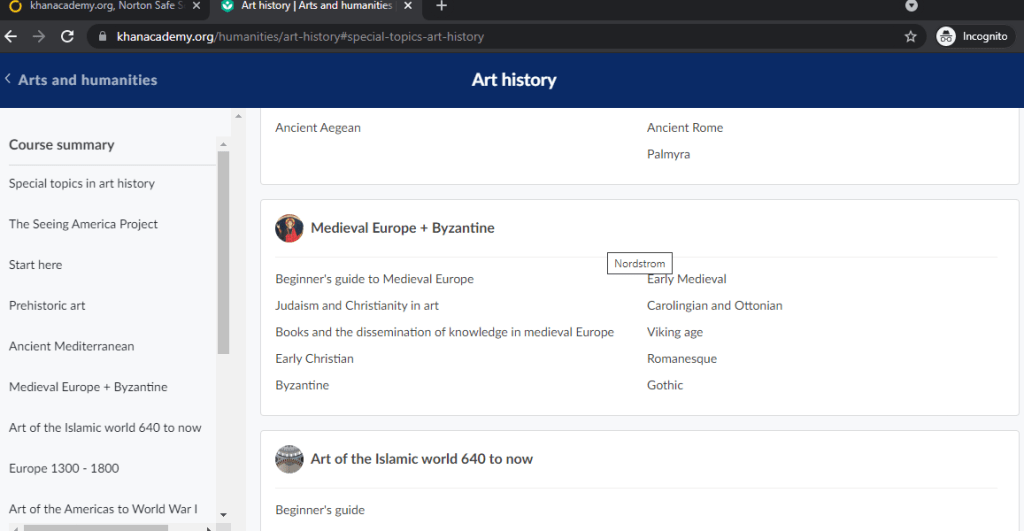
Khanacademy is another versatile website that is a must-have teacher resource for several subjects, but art in particular. Short Videos of relevant artworks or art sites are selectively combined with subject area terms and questions, like How to analyze a painting, or Understanding Color Theory, or Perspective Drawing. Its an extremely easy site to navigate, and while it is has a subject centered approach to learning there are quizzes and interactive parts to the website. In the essay sections on art and the videos – there are a number of different social considerations and critical analyses given to creating an understanding of the social attitudes inherent in different art periods seen though paintings, sculpture or architecture. The essays on Khanacademy.org also add to student research possibilities and themes.
Khan academy really gets it – in putting across the importance of Art & Culture in understanding civilizations. Art is one of the long surviving visual languages of that civilization and if students can understand and appreciate the art from a country or nation, then it gives them a much deeper insight into the cultural heritage, belief systems and (tropes too -) of that culture. Khanacademy also has an organized resource of videos on the Arts, Sciences, Mathematics and so on. So good for watching the Fibonacci Sequence demonstrated ! See https://www.khanacademy.org for free online courses and Lessons.
The Circle Line Art school – see below – on YouTube is another magic website on Perspective Drawing for a grade 8/9 Class. With YouTube videos students can follow along at their own pace, and get the practical techniques through careful observation, in several different steps. There are places to add comments or get feedback from the author of the site. See :
For Comments on Readings or Art Community Websites – type add your comment below.


References:
Florio-Ruane, Susan (2001). Teacher education and the cultural imagination: Autobiography, conversation, and narrative. Michigan State University.
Mitra, S. (2010, July). Sugata Mitra: The child-driven education [Video file. Retrievedfrom http://www.ted.com/talks/sugata_mitra_the_child_driven_education
Watson, C. (2014). Effective professional learning communities? the possibilities for teachers as agents of change in schools. British Educational Research Journal, 40(1), 18-29.
URL https://youtu.be/LCCqwJ4cuxg
Career Life Education- Communities of Practice:
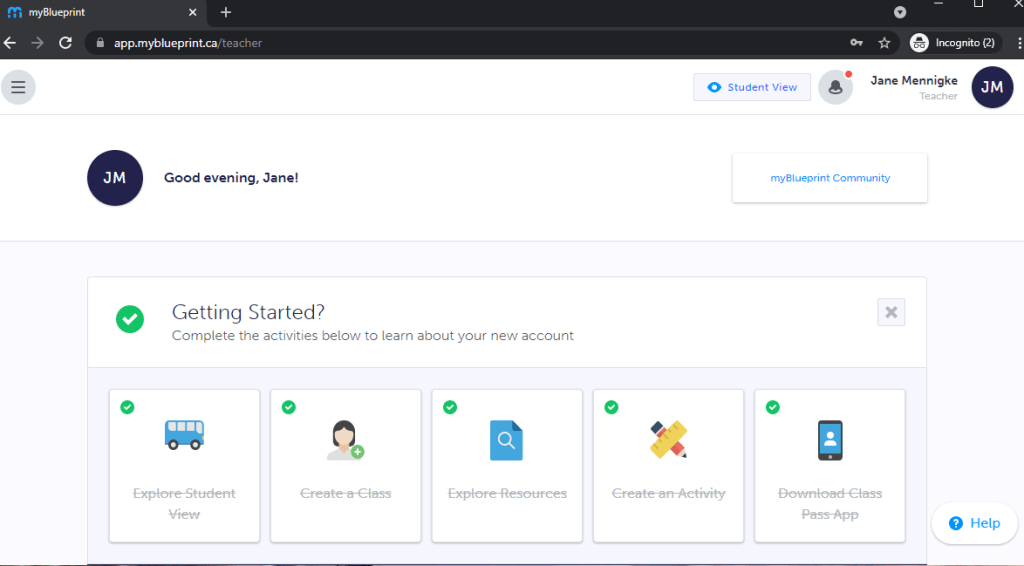
On Career Life Education10 there is a Platform /website called www.myblueprint.ca which the students and I use. There are opportunities to get involved in discussion on their website and follow webinars on how to add information to the site or get involved in career opportunities. I don’t have much more to add on the public forums – but this site helps students build a portfolio of personal interests/ goal setting/ personality type- preferences/ college and university course pathways and career related quizzes and support documents, or worksheets on finance and budgeting. All in one place. Actually there are still elements on this website that I could explore more deeply – so we can use it more effectively.
For Relationship and Sexual Health Education workshops at www.shifteducation.ca . Jessie Wollen is a BC health educator and teacher who offers workshops for students. This is a really useful 1-2 day workshop which students love. It really gives them the common language they need to talk about social, emotional and physical health, caring for our body, norms in relationships and what this looks and feels like, how to confront inappropriate or non-consensual behavior from anyone. There is a lot of discussion which Jessie fields on Zoom, with teacher help during Covid times. An excellent resource which really fits into a teaching ethos which is learner centered.
BC Teacher Federation: https://bctf.ca/blogs/research.aspx This had an old post from 8 June, and it was difficult to subscribe, but I will pursue it. I found an article at the top of the page and then found out it was from years ago. Glad I didn’t post anything! I believe they are working on a new website.
References:
Florio-Ruane, Susan (2001). Teacher education and the cultural imagination: Autobiography, conversation, and narrative. Michigan State University.
Mitra, S. (2010, July). Sugata Mitra: The child-driven education [Video file. Retrievedfrom http://www.ted.com/talks/sugata_mitra_the_child_driven_education
Watson, C. (2014). Effective professional learning communities? the possibilities for teachers as agents of change in schools. British Educational Research Journal, 40(1), 18-29.
____________________________________________________
 Songololo Times