Post #8 Innovation in Teaching and Learning.
Final Blog Post – to conclude this Module.
In several articles written by Jessica Ball, she talks about the generative curriculum model as it has been developed in her practice, working with Indigenous educators, and in her research in this field through the University of Victoria. Practically speaking, it is a student-centered classroom. With this in mind, members of the community are invited to share their knowledge on community issues and needs, which students can participate in learning about, researching and problem solving. Students are in a reciprocal learning environment where their contributions are appreciated and acknowledged. The teacher forms one member of this participating community who is responsible for facilitating, engaging and collaborating with student/community partnerships. Jessica Ball(2001)
The instructors in the Generative Curriculum Model are required to act with all of the 7 Principles of Indigenous Learning (Respect, Bravery, Humility, Truth, Wisdom, Love) as they engage in establishing learning which is “ structured using an “open architecture method of instruction,” voices from the students and the community (add) to constructivist teaching and learning.” Ball, (2004), pp 462.
So Lets recap on some of the essentials affecting Creativity and Innovation in Teaching and Learning – as it affects SLL.
In a generative curriculum model, classes are designed in a community centered way which is far more adapted to the needs of the community, their relevant questions, and textbooks/online resources are used to support this learning in culturally appropriate ways. The use of these documents is the compliment to learning, as well as a source for critique, analysis and comparison by elders, and students. As I have stated before, the integrative example that this model sets for us as teachers and learners is far bolder than a simple adaption of curriculum to suit the needs of the students. This is a radically transformative approach to teaching and learning which relies on the Instructor simultaneously being : Learner ( listening and engaging in this community of learners, and following social cues), Instructor (sharing and assisting in organizing information which is both Multicultural knowledge systems and Indigenous knowledge systems ), Enabler, Researcher and Facilitator.
As I am working in an International school with multiple nationalities, in a Canadian context – inclusivity, and generating relevant curriculum in classroom and community partnerships is both challenging and rewarding. As a result of the readings, the contributions of my peers on this course, and this Blog, I feel more equipped to step out of my comfort zone in a conscious shift to more student-led classroom facilitation. EeeeeeeK!
References:
Ball, Jessica. A generative Curriculum Model of Child and Youth Care Training, Journal of Speech-Language pathology and Audiology· Vol. 25, No. 2, summer 2001
Ball, Jessica,As If Indigenous Knowledge and Communities Mattered: Transformative Education in First Nations Communities in Canada. American Indian Quarterly , Summer – Autumn, 2004, Vol. 28, No. 3/4, Special Issue: The Recovery of Indigenous Knowledge (Summer – Autumn, 2004), pp. 454-479, Published by: University of Nebraska Press.
Note: Second last paragraph/ Taken from Module 3 Readings/my comments on Ball(2001)
An infographic which encapsulates some of my learning for this final entry is not yet complete but I hope to add it in the next week.
_______________________________________________________________________________________
Post #7 Innovation in Teaching and Learning.
Teacher Identity is a fascinating chapter of Lesley S. Keiler’s article. It separates teacher roles and teacher identities.
“A teacher’s role refers to what they do in classrooms and a teacher’s identity is the way the teacher thinks about themselves and their classroom roles. This work builds on Grier and Johnston’s (2009) argument that, “Teacher identity is based upon the core beliefs one has about teaching and being a teacher that are constantly changing and evolving based upon personal and professional experiences”.(p. 59).
She also explores what other literature says about how teachers identities are affected by implementing new instructional models, Davis et al.(2006) and yet these changes are processed and influenced by a community of practice (Freedman and Applement 2008 ; van den Berg 2002; van Huizen et al.2005) and finally – how students play a pivotal role in the formation of teacher professional identities. For example with students who act as peer leaders – these form a community of practice. Proweller and Mitchener(2004).
These ideas really ground my thinking about some of the challenges and what they mean for a Student-led Curriculum in practice. I can see that teacher-identity, what I might hold onto, would need to undergo a change. Sharing the stage, giving it up at times, acting more like a full-on facilitator, movi-director, cameramen/women. Ha! Not so bad, after all!? Or, maybe more like a sharing of all those roles! Teaching can be a bit like acting. Student-led Learning would include role play and role switches if it was shared teaching and learning. That aside, the knowledge sharing role, is the one that I keep coming back to and which resonates. It affirms the Indigenous classroom in practice. It affirms all that I have read about Place Based Learning, which I have to thank Danica for introducing me to, and it offers a reciprocal role of responsibility between teachers and learners which places students in valued positions to share their current and developing knowledge.
I just have an image of students in a classroom coming to class with very little control over how the class with go, versus coming to class with their own ideas to implement and grow!
In the Art room, there are so many extraordinary ways that students can be teachers, or be learners of skills that they wish to perfect without me. There is YouTube, KhanAcademy, The Getty Museum, The Met, Tate and the gazillion other gallery or artists’ websites in Canada and abroad, plus Art21 among others. I teach and manage resources, make links to art history and theory, demonstrate art methods, show examples, ask questions, give suggestions and showcase student work in exhibitions. I have often used peer teaching when I have a big class, but there are still many, many things that seem to hinge on me directing, knowing, or being there. I have a sense that Student- led learning is far broader in many respects than I had realized before, and that the sense of student ownership will be incredibly satisfying to be part of.
Maybe there is time this week for one more post before the assignment is due 😊 It’s been quite a ride!!
Keiler, L.S. Teachers’ Roles and Identities in Student-centered Classrooms. IJ STEM Ed 5, 34 (2018). https://doi.org/10.1186/s40594-018-0131-6
________________________________________________________________________________________
Post #6 Innovation in Teaching and Learning.
We start with this question from the last post:
If the teacher’s identity is changed because they are no longer the Sage in control of the learning materials, who is affected by this outcome more – the teacher, or the students? Or both?
Keiler writes in her chapter “ Teachers’ roles and responsibilities in student-centered STEM classrooms” – that effective implementation of these changes in teacher’s roles and responsibilities requires understanding of the constructivist nature of the student-centred classroom which is both iterative and enquiry-based instruction.
According to Moustafa et al. (2013), in constructivist classes “(t)he teachers’ role is to encourage and accept student autonomy and create a comfortable atmosphere for student expression,” acting as guides for their students (p. 418–419). Constructivist teachers behave in marked contrast to traditional instruction where teachers dominate the classroom and provide direct instruction focused on content knowledge acquisition. Friere saw teachers as partners of students who were pursuing agency as opposed to teachers being “positioned as enforcers, disciplinarians, and police officers” (Gutstein 2007, p. 424).
Well, it sounds a bit harsh on us teachers but, yeah, I know I’ve told the odd student or three that I’m not a policeman! So – at worst, the classroom can feel like we are marshalling the troops, and they are all in different lines going helter skelter, and at best we are all engaged, wisdom and art is in the air, and we are on the same page, or mostly on the same page!
Returning to “ where teachers dominate the classroom and provide direct instruction focused on content knowledge acquisition.” We have the Sage again, or at least some form of the Sage. The fear of losing this identity reminds me that Knowledge/Wisdom are both concepts , and archetypes: The Sage, and the Wisdom Keeper.
According to Basu and Barton (2010) “teachers must learn to share authority with their students, enabling the student to make instructional decisions that the teachers support and enact.”
In her book titled “ Big Magic,” Elizabeth Gilbert refers to the fears artists have about losing their creativity. Creativity, she writes, in Greek times, was looked upon as an endowment of the gods, not as something possessed by an individual. The ancient Greeks would say “ I was visited by Creativity!” It was not until the Renaissance, that creativity became associated with the concept of the ‘universal man’ a type of superhero of individual creative, scientific, and mathematical genius, markedly present in such people as Leonardo da Vinci and Michelangelo, that the concept of creativity was adopted as an individual trait. We have lost that understanding of Creativity being bigger than ourselves, lost the idea that we can be visited by Creativity, that Creativity is waiting to visit us, and that if we do not make a home for Creativity, then Creativity will find someone else to visit!” Gilbert (2015).
I thought of this today in direct relation to the idea of the teacher as Sage and Wisdom Keeper. Perhaps teachers would find it freeing to think of K n o w l e d g e in the same way as the ancient Greeks thought about Creativity. Who will Knowledge visit today? Who is paying attention to Knowledge today? Knowledge is present, waiting to visit someone who will enjoy and celebrate the gift! And, If you don’t use Knowledge she will find a home somewhere else perhaps, just like Creativity! No need to assume the role of the Sage, just pay due diligence, and do our part.
In the next Blog Post, I will look at how Keiler’s research into teacher identity demonstrates ways teachers’ roles would shift in a Student-led Classroom.
References:
Keiler, L.S. Teachers’ Roles and Identities in Student-centered Classrooms. IJ STEM Ed 5, 34 (2018). https://doi.org/10.1186/s40594-018-0131-6
Gilbert, Elizabeth, (2015). Big Magic: Creative Living Beyond Fear.
________________________________________________________________________________________
Post #5 Innovation in Teaching and Learning.
Blog Post #5
All I can see right now are problems.
The problems are connected to : What – in this process of Student-led Learning(SLL) is just window dressing? It all looks like there will be plenty to do in a(n) SLL Classroom. But what are the issues? What will emerge? What is the downside? There is lots of data on how beneficial it is. I can believe it! But….is this the whole story? If its so great, why is it not becoming the norm in every classroom?
I came across an article called Teachers’ Roles and Identities in Student-centered Classrooms by Leslie S. Keiler. She addresses the changes happening in the classroom, in the face of multiple challenges in preparing students for further education, careers and as future citizens.
“Educators have advocated for student-centered instruction as a way to meet these challenges, with multiple programs emerging to shape and define such contexts. However, the ways to support teachers as they transition into non-traditional teaching must be developed. The purpose of this study is to explore the impacts on educators of teaching in student-centered, peer-mediated STEM classrooms and preparing student peer leaders for their roles in these classes. Research questions examined how teachers think about themselves as they implement student-centered pedagogy, the difficulties they face as their roles and identities shift, and the ways they grow or resist growth.”
Most articles I have found address challenges facing STEM classes and have nothing to say on challenges facing the Visual Arts Classroom. But, I will come to that point later on.
Keiler (2018) speaks to my question “What is the downside of a(n) SLL Classroom?” Her article supports the research evidence suggesting teachers may feel their identity is threatened in some way. Teachers will need to redesign classroom interactions/ facilitations without the desired training, very often. Teachers will not be the knowledge keepers. They will have to share this role with their students. Classes will be a sharing of knowledge.
Ah! Teachers will no longer be the fountain of all Wisdom or, was it at least a Stream of Wisdom? Or, most certainly were they not the Appearance of Wisdom?
Modesty aside – good teachers are generally also good facilitators! Is the SL classroom not really just a different type of facilitation? Facilitation takes skill. You are on the hop, have to listen closely, pick up verbal and physical cues, have to be prepared ahead of time, cope with unforeseen events, interruptions, and unexpected student responses. Good facilitation is a balancing act, it is gauging your audiences response so that you can challenge them to get outside their comfort zone, into a learning zone, but knowing when to buckle up, check the safety gear, check everyone is on board, consolidate, reflect, or be at ease, let go.
So, if the teacher’s identity is changed because they are no longer the Sage in control of the learning materials my question is – who is affected by this outcome more – the teacher, or the students? Or both?
That is a question for next time!
________________________________________________________________________________________
Post #4 Innovation in Teaching and Learning.
Student-Led Curriculum. Today I am adding research/thinking/reflections on the question How does Student -led curriculum actually work in practice? and What does a teacher do in a student- led educational setting?
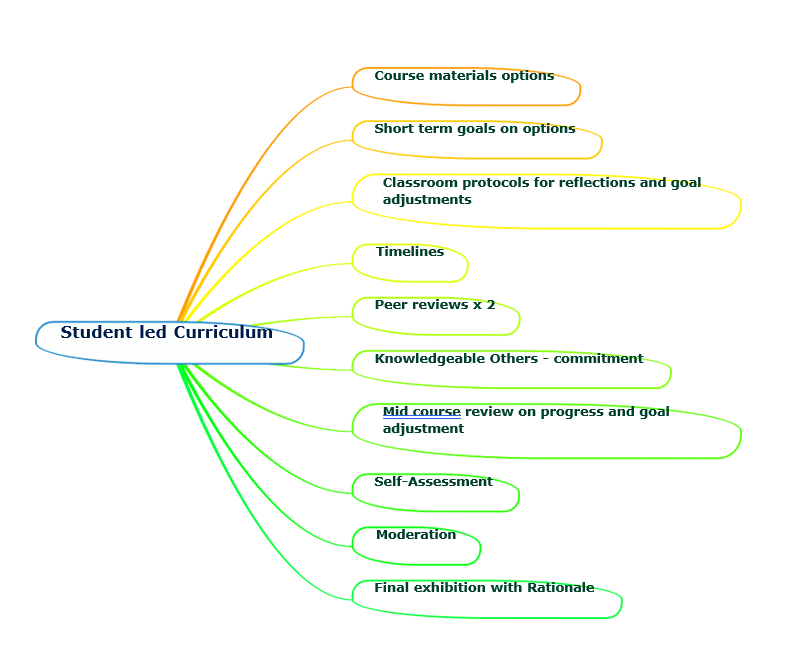
A student-led learning environment looks different from a traditional learning environment. So its good to have pointers and explore the ways a teacher needs to support this process. What does the classroom look like in a Student – led Curriculum in practice. A website called the Experiential Learning Depot run by educationalist Sarah Segar, gave me points to consider and reflect on. I also added to or adapted her points when needed.
- Teacher uses open ended question techniques, asks quality questions and teaches students how to do this by probing questions and with support.
- Teacher engages students in explicit instruction on research processes and website fact-checking, referencing protocols; invites range of methods to express/articulate learning.
- Student group projects/collaborations encouraged and supported.
- Reflection and reflection-for-adaption methods are explicitly taught.
- Student-led discussions, conferences, are the norm
- Student as teacher (also a method of providing performative feedback on learning)
- Peer assessment/feedback strategies are taught
- Multi – genre projects. ( http://www.gesseeducation.com ) ‘The purpose behind the creative classroom is to empower learners through independent work so they learn how to be self -managers and self-starters’ and, ‘ this will need more emphasis on personal pedagogy, individual experimentation with concepts, as well as intertwining subjects, making connections and seeing relationships, envisioning what might be. Teachers are leading learners to find the problem by themselves creatively or to present specific problems and asks learners to apply all sorts of available resources to find the best, satisfying solution creatively.’ And, “Educators who frequently assign classwork using creativity are more likely to observe higher-order problem solving, critical thinking and making connections between subjects, in their learners.”
So, now I had adapted and added to the list provided by the experiential learning depot, I was asking the question: What more can be added to the Teachers Role in a Student-Led Learning Environment? A simple explanation of this would be helpful.
Remedian Dias says: In Student -led learning classrooms, Teachers can do the following:
- Guide students in developing skills for self-direction
- Get to know students
- Manages personal learning plans
- Help students find resources
- Organize learning activities and help students manage adaptions
- Provide input and feedback
- Assist students with project design
- Organize events to showcase work
- Provide students with the tools to be successful
- Manage classroom dynamic.
I found a helpful comparison of differences between a teacher-led classroom and a student led classroom from resourced@prometheanworld.com
| TEACHER -LED CLASSROOM | STUDENT -LED CLASSROOM |
| 1. Traditional pedagogical methods | 1. Modern learning techniques |
| 2. Lecture style lessons | 2. Groupwork and collaborative projects |
| 3. The teacher at the front of the class | 3. Pupils in control of their learning |
| 4. Learners absorbing knowledge | 4. Learners being self-aware |
I would add thoughts to these examples in Student-Led Classroom#3: Pupils in control of their learning and engaged with reflecting on problems, problem solving, enquiry, and data reflection. Students may all be in different stages of this process moving at their own pace in directions which keep them interested in contrast with….
I would add thoughts in Teacher-led Classroom #3: learning is paced in such a way that everyone is expected to work at roughly the same pace, on a similar topic and find similar outcomes from their investigation. Too much disparity in pacing can create log-jams for students who want to move ahead, and being left behind for those who are not ‘keeping up’.
Selecting other online resources to use in planning can be a double edged sword (Curb creativity and innovation as well as free up some ideas. ) It would be valuable to reach out to one or two of my colleagues and invite feedback in planning a course. I will do this before the next entry.
References:
- Segar, Sarah, What does the teacher do in a student- led learning classroom environment? http://www.experientiallearningdepot.com Accessed Aug 6, 2022.
- Dias, Remidiana. Empowering Classrooms with Student-led Learning. Article, Gesseducation Website on Student-led learning. http://www.resourcesgesseeducation.com accessed 7 August 2022.
- GESScast PodCast Episode 17 – Russell Cailey Director of the Centre of Innovation and Training, Global Education, THINK Learning Studio.
- Promethean ResourceEd (2020) A Promethean Blog. Student-led vs teacher-led learning resourced@prometheanworld.com Accessed Aug 6, 2022
____________________________________________________________________________________________
Post #3 Innovation in Teaching and Learning.
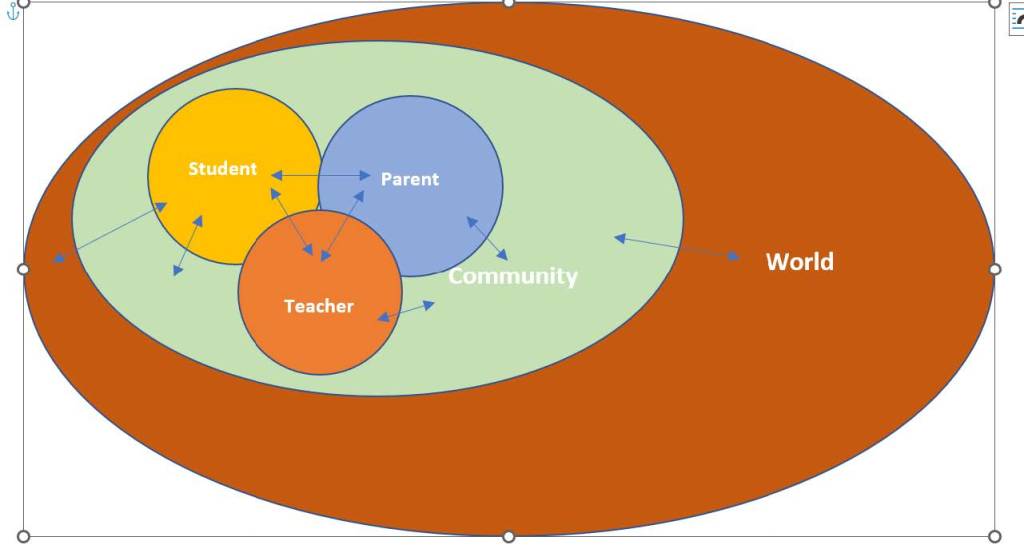
The Question: How To Make Students Co-Creators of Curriculum?
I found a book called Learning Together, by authors Barbara Rogoff et al, This was referenced in Jessica Ball’s article: As if Indigenous Knowledge and Community Mattered. Transformative Education in First Nations Communities in Canada.(2004).
“The book reveals how children and adults learn through participation in activities of mutual interest in an innovative study involving teachers, learners and parents who collaborate in co-creating curriculum. Insights will speak to all those interested in how people learn collaboratively and how schools can improve.”
After reading several chapter briefs, it seemed innovative, but more drastic perhaps than what I had in mind: whole school buy-in, and parent/ teacher/community meetings to establish ground rules and philosophy and schedules for the year seemed a lot to organize. I was looking for ways that in the context of The Art Classes in the International school I teach at, students can co-create curriculum in ways that address fundamental biases towards European Art. Simply put – ways that students can add to curriculum study through drawing on their own country’s art heritage, culture, and innovation.
A book review by Carla Wilson on Decolonizing Methodologies: Research and Indigenous Peoples, by Linda Tuhiwai Smith, (1999) Zed Books, London has the following to say on the authors contribution:
“She rejects the term “post-colonialism” as it implies that colonialism is finished business and argues that colonialism continues to have a profound impact on Indigenous peoples. Tuhiwai Smith points to research and technological advances by corporations and governments, particularly with regard to the environment, which fail to recognize Indigenous belief systems and knowledges. This book provides a reminder that colonial paradigms continue to evolve and to marginalize Indigenous groups, and that non-Indigenous researchers need to consider how their “worldview” may (re)inscribe the dominant discourse of the Other.” The reviewer notes that Tuhiwai Smith groups all Indigenous perspective’s together, which is in itself problematic. The question is also, how to give prominence to other cultures and more student-led curriculum, as innovation, without still by implication, using the same method of critique/interpretation/assessment as one would for predominantly European works of art. A new mindset needs to be a new mindset! Artworks vary considerably from country to country or even community to community.
The take-away for me:
Innovation in Teaching and Learning means recognizing that I come to learning with a worldview that may be centered on a western understanding of cultural history – that considers itself as ” both the dominant culture and the center of legitimate knowledge.” I need to create space for alternative worldviews and create a learning environment of respect and honoring so that stories, artefacts, and knowledge keepers are given space in the classroom to create a more balanced worldview. I had almost forgotten the examples below when I started this enquiry. They are not fully what I have in mind, but they lean towards a student led curriculum.
CLE 10: Example A: Students in my CLE 10 classes have created their own Curriculum when I asked them to create a Goal Plan, and short-term goals, to learn a transferable skill over two months. The self-monitoring process worksheets and accompaniment by knowledgeable others was fundamental to their success. Some of our in-class time was given to practicing their skills (Sign Language, Ukulele, Guitar, Baking, Short-story writing, Chess, SketchBook Pro, etc) but much of it they did at home in their own time. It was completely worthwhile, and they were extremely motivated to do well.
Art Classes: Example B I have used a similar method for 1 term, with a Grade 10 and a Grade 11 Art class. Their goals were different based on what skills were closest to their interests. They had every lesson to work on their art project and could chose to work overtime as well. They chose a range of topics: Figure Drawing, Digital Media – SketchBook Pro, Anime, Ceramics, Model Building for film set, and so on. While most of the class did very well, attainment levels were high, motivation was high, it was harder for me to help the underachieving students. Three out of twenty -six students did not reach out for knowledgeable others or YouTube videos, or take any responsibility for their learning, they drifted around aimlessly and said they were working at home on the project. Four others could have done more, with more self reflection and subsequent adjustments. The aimless students were much harder to manage, and in the end their results were underwhelming. I think part of the problem was that they didn’t want feedback of any sort, from me, peers’ or others. And, part of the contract with a self-set study (student-led Curriculum) is that you need to share learning, reflect, and make necessary adjustments as you go along. This is what success looks like! This does offer challenges to the student-led Curriculum idea. However, more time could have been given to explaining the idea and receiving buy-in from the students on what their participation would look like week to week.
Learning: Student- Led Curriculum would need a set time to establish what the goals are, a structure for selecting worthy topics, which are moderately difficult or challenging but attainable with required effort, and establishing a process of monitoring, and final delivery.
Art Curriculum offers lots of opportunities, but working with Student-led curriculum would be more fluid. How does one maintain a sense of freedom while still maintaining high enough standards. How does one prevent it becoming unmanageable and unsatisfying? I think this would be for another post.
References: Image A : Student-led Curriculum is Inter-connected Worlds (Mennigke). Example A and B – Teaching experience in two North Vancouver Schools. (Mennigke). Rogoff, CG Turkanis, and L Bartlett. Learning Together, Children and Adults in a School Community. New York. Oxford University Press. (2001). Book Review by Carla Wilson on Decolonizing Methodologies: Research and Indigenous Peoples, by Linda Tuhiwai Smith, (1999) Zed Books, London.
POST #2 Innovation in Teaching and Learning.
Optimal digital use/ratios for classroom learning: After reading ChanLin Analysis of Teacher Tablet teaching Adoption Process.(2017) the questions I had were around balancing the obvious positive innovations and apps available for classroom use, with its opposite – the “craziness” around technology in the classroom. So I created an infographic to illustrate two specific type of digital/ Tablet classroom use. Digital Interactive, and Digital Solo: It is assumed that the teacher is interacting with students in both forms of digital use, but in the diagram on the left students are also using technology to interact with each other and not solo.
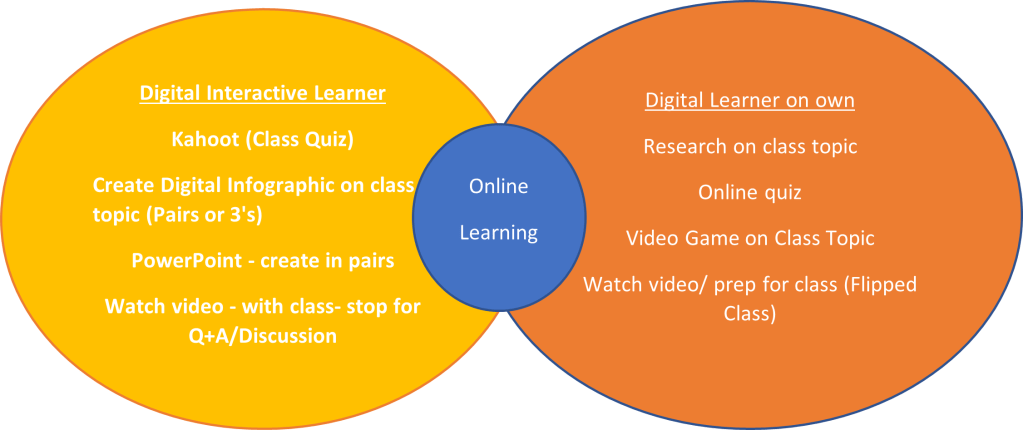
Key: Online Learning Infographic created in response to ChanLin, Lih-Juan. Analysis of Teacher Tablet teaching Adoption Process.(2017) Article, Educational Sciences, Theory and Practice, Publ. Nov 10 2017
Orange: Online Learning without other learner Interaction Yellow: Online Learning in small groups, pairs, or class-group.
Readings on the article by ChanLin(2017)- and Reflections
- “ Four main elements influence technology integration: the innovation itself, communication channels, time, and the social system (Roger, 2003). The five stages of adoption include: awareness, interest, evaluation, trial, and adoption (p. 79). To bridge the use of tablets with students’ authentic learning environment, teachers need to be aware of the ubiquitous ownership of tablet learning, and design activities to encourage students to tackle real-world problems and to challenge themselves with the given tasks (Burden & Kearney, 2016). ” Chanlin (2017) pp1937.
2. “The use of the tablets also made the children engaged in multidimensional ways of thinking and learning, which totally differed from what they had experienced before. One of the most interesting aspects of the use of the tablets was exploring the diversity of applications. Some of these applications were powerful tools for specific subject learning, for example, Staria for learning astrology, Smart Microscopic for learning biology and Evernote for note-taking. With these tools, the children were able to interpret knowledge with meaningful representations. Even the children with special needs felt comfortable with the interface for assisting their learning. For the teachers, the adaptation process entailed their openness, accommodation, and willingness to learn with the children. The children were inspired to explore new features and new ideas when trying out the tablets and applications.” ChanLin92017) pp1947
Reflections on Quote 1: ChanLin notes that the social system plays a role in integrating tablets into the classroom learning space as well as other factors. He is also advocating for designing activities for tablet use that allow students to address real -world problems. Giving guidelines for Tablet- etiquette and monitoring this intentionally, speaks to social systems of behaviour and connection between students/students, and teacher/student during learning. The diagram above separates tablet-use into two functions in the classroom. My aim would be to ensure a balance between these two tablet uses, and create spaces for non-tablet use in learning.
Reflection on Quote 2: Aside from this quote, Chanlin quotes Moats, (2015) who argues that incorporating tablet technology into students’ learning creates additional challenges and anxieties for managing classroom settings, and that these anxieties or challenges may result in teachers’ rejection of the technology. I found Chanlin to be articulate in arguing for tablet use in the classrooms because a broader, layered approach to learning is attractive:
“ The use of the tablets also made the children engaged in multidimensional ways of thinking and learning, which totally differed from what they had experienced before.” ChanLin (2017)
We are a few years on from this article, and there is no doubt that students whose whole senior schooling has incorporated laptop/tablet use in the classroom, in both online learning at times during Covid19, or in person, see digital interactions as the norm. It’s not just teachers though, who experience anxiety or performance anxiety around tablet use. Students themselves are at various skill and comfort levels of technology use. Teachers/Instructors need to make sure that technology use is indeed as multidimensional as ChinLin suggests. My thinking around this suggests a combination of interactive and solo platforms (Interactive – with other classmates, and solo – on their own). See the Diagram above. With this diagram in mind, anxieties around tablet use need to be mitigated by ensuring that both instructor and students understand that they are learning together in a school community and combining their common resources to give direction to teaching and learning.
Thinking about Tablet uses – also creates a question I have around Student-led Curriculum. This is on the back burner. I will save this for another post.
References:
ChanLin, Lih-Juan. Analysis of Teacher Tablet teaching Adoption Process.(2017) Article, Educational Sciences, Theory and Practice, First Published Nov 10 2017.
_______________________________________________________________________________________________
POST #1 July 2022
Reflective Practice as it relates to Innovation in Teaching and Learning.
I’ve always thought you could learn everything through the Arts.
That is to say, the Arts, Visual Arts, Music and Drama contain all the seeds and fruits of education. But then, I am foremost interested in how the Arts connect all sorts of diverse information.
We have just lived through the Pandemic of Covid19. There is no doubt in my mind that we all turned to literature, music, dance and film to stay sane throughout this very difficult time of social separation. Yet many educators still see STEM subjects as far more important for getting ahead in life or containing any real educational value.
The reason I see Art connecting everything is because a timeline of artistic achievements since prehistoric art contains the seeds of every culture, history, and invention.
And so what?
Well the nub of it is the question: How does the current education system show innovation in teaching and learning? A lot of the creative, exciting developments and commentary on education by educational psychologists and theorists doesn’t end up in general use in the classroom because there is a matrix in use already.
As an art teacher, I have explored innovative approaches to student self-assessment in my classroom. The reflective practice that goes with that, means it is sometimes a little more work for me, but the students understand the requirements and are generally pretty accurate in assessing their work because we have had opportunities for discussion on what we need to assess, ideas generation for the task, sketchbook documentation, and final artwork requirements. I moderate their assessments and give feedback on areas for growth if the student hasn’t already noted this on their evaluation. I praise an area of growth, or responsiveness to instruction and reward their development or appropriate action taken to improve the final artwork.
There is a large hiccup though. What I find challenging is how to develop innovation in learners who are reluctant self-starters. It is as though our education system is creating more complex webs for articulating student achievement in an effort to make it more accessible, which is having the opposite effect – acting as inhibitors to problem solving in areas not directly linked to the task. This does not simplify the process for learners or educators. There are just too many words to measure achievement.
Classroom reflection tends to be more superficial over a lot of avenues rather than at depth. I’m not sure how to change this in my classroom, and so my reflections over this Blog will be on trying new methods in classroom reflection on tasks, and to see what comes about as a result of this.
Also, I’m not always sure that I’m giving my students enough feedback or chance to reflect on what they have actually learnt, before rushing onto the next section of work. So this will also be a chance for me to reflect with them and hear their ideas on their learning in a more systematic way.
Another inhibitor to student and teacher self reflection is the quantity of new information on every topic which makes it easier to be an observer of processes than a participant in the action.
Would ‘ Pride and Prejudice’ have been written in a digital age?
 Songololo Times